Way back in the first few weeks of this challenge, I wrote about fatigue setting in. That first shot of eager adrenaline was wearing off and I was beginning to feel worn down. I was beginning to wonder if I would be able to keep up this challenge for a whole year.
What I didn’t know then, is that this was a cycle that would come and go repeatedly over the coming months. Now, I’m nearly halfway through the challenge and I feel that fatigue settling heavy on my shoulders once more.
February actually started off really well. For the first two weeks, I was writing steadily with no problems.
Then this past weekend hit me like the hardcover edition of War and Peace and I find myself wishing for a break.
Don’t get me wrong, I still got my word count in. I’ve been pretty good about not falling behind in this challenge. But the level of difficulty increases exponentially when I’m feeling fatigued—not to mention I don’t think my work is as good. And when the work gets harder, it takes me longer to complete, thus increasing my fatigue. It’s times like these that I wonder if trying to keep up with this insane word count is really worth it.
Part of my current problem is simply that I haven’t had a break from writing in weeks. I knew that was how February would be, and I was prepared for it, but it’s still taking its toll on me. And I’m only halfway through the month. I just can’t seem to get enough extra words a day to give myself the cushion I would need to take a day off. So, what am I supposed to do?
But, one of the benefits of having gone through this cycle before is that I know—for a fact—that this, too, shall pass. If I can work through this weariness, I can hit my stride again.
That, I suppose, is what I’ve learned this week. I’ve learned that good times will go and bad times will come, but they never last. Milwordy has given me enough experience with my own writing cycles to know that the best thing I can do is just keep going. Just keep writing. I can make it through.
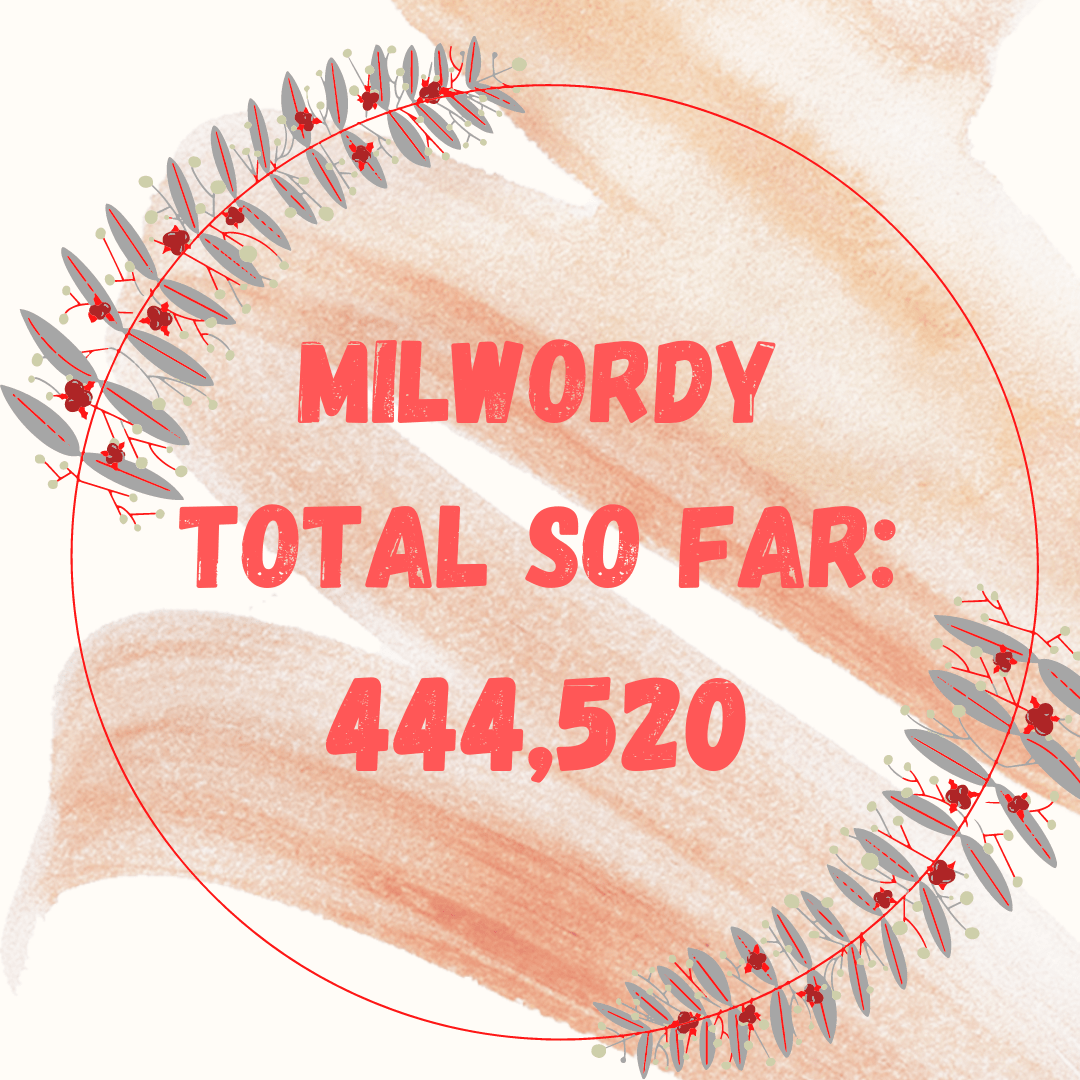
And unless I fall completely apart, I will be hitting the 500k word mark next week! It’s all downhill from there, right? I just need to keep hanging on.
If you’ve been enjoying my blog, please like, follow, and share it. If you have any questions or comments, please feel free to leave them down in the comment section. Thank you for reading!
That’s what I called the novel I wrote in 2017 and partially revised in 2018 while I was trying to come up with an actual title.
Spoiler alert! I still don’t have an actual title.
I never finished revising it and currently it’s sitting in my document folder, staring at me like my cats do when it’s 20 minutes until dinner time and they’re convinced I’ve forgotten about them.
I have not forgotten.
Though I would never give up on my cats, I am debating giving up on Pirates! It’s not that I don’t like it anymore. I do. I just feel like I was an entirely different person when I wrote it. My life is entirely changed and I don’t know that I can go back to it without completely rewriting it.
It’s heartbreaking. I loved that story, those characters, that setting. And I still do. But sometimes you can’t go home again, you know?
Also, in keeping with the theme of pirates, I have plundered that novel and used some of the elements for other stories. For instance, I apparently have a fixation on over-protective older siblings and rebellious younger siblings finding a way to coexist. That theme has appeared in more than one of my stories since I originally wrote about it in Pirates! Is it repetitive to keep returning to that well? Would that make returning to Pirates! pointless?
I mean…the stories are different, but seriously…find a new theme Robin.
On the other hand, is this just example of not finishing something I start? Am I making excuses to follow the shiny new ideas, which will inevitably lead to me never completing anything at all?
When is it time to tough it out and keep going? When is it time to move on? How am I supposed to know the difference?
I don’t yet have an answer for this, but I think I’m going to start by rereading what I already wrote and see if it sparks any joy for me. Marie Kondo isn’t just for physical possessions, you know? If it doesn’t, then maybe it’s time to say goodbye. If it does…well, I guess I’ll have to figure out my next step from there.
Have you ever chosen to quit a project you loved? Have you stuck with a project to the end, even when you weren’t sure you should? Were you happy you did?
I told you last week that February was going to be a difficult month for me. Because of the shortened month, my daily word count increased from 2,688 to 2,976. Sounds a lot harder doesn’t it? So far…it hasn’t been.
I think part of this has to do with the fact that I was anticipating that it would be hard. I made sure that I got up by 5:30 AM every day this week because I was so worried about falling behind on my word count. And every day, I managed to get the full 2,976 words before I went to work. It feels fantastic to have written all my words before my day has even really started.
An observation here, though: I’m not getting many extra words. In other months I would typically have some days where I just happened to write 4-5k. This was an advantage because I could afford to have days off. The highest word count I’ve had so far is 3,010 words, which is awesome, but it’s not going to earn me much time off in February. I don’t know if this is sustainable for the whole month, even if it is a short one. I haven’t gone a month yet where I haven’t had several days off. I’m not sure if I’m capable of getting nearly 3,000 words every single day for 28 days in a row. I guess we’re about to find out together.
One of the most important things that I’ve learned from Milwordy so far is that having a solid routine is key. That’s never been truer than it has been this week. If I do make it through this more intense month, I think it’s going to be entirely due to the fact that I’m starting to respect the routine and make sure I stick to it.
That’s all for this week. I hope you are enjoying this blog. If you are, please like, follow, and share it. Let me know your own thoughts on routine. Do you have one? Or do you thrive on spontaneity? Or something in between? I would love to hear about it!
Sometimes I’m so excited to work on a particular novel that it’s all I can think about. I’ll sit down at my computer, the smell of my apple pie wax-melt wafting directly into my olfactory receptors, and I’ll put my hands to my keyboard. And as I stare at the blank screen in front of me, I’ll urge my fingers to just move. But they won’t. My brain just won’t work.
Why does this happen? Why, when I was so eager to get started, do I have such a hard time beginning?
I suppose there are probably a lot of answers to this question, but the one that I’m finding to be my biggest problem is the fear of failure.
The thing is, I don’t have any problem sitting down and banging out a few thousand words of backstory. But when it comes time to write the actual story, then suddenly the words flow like molasses.
A lot of my words during this Milwordy challenge have been backstory/outlines. I’ve done a lot of drafting as well, but it’s noticeably more difficult.
What it comes down to, I think, is that those backstory words aren’t meant for anyone but me. I don’t have to worry about them being particularly well-written because the prose isn’t really the point. The story is the point. Getting to know the main character is the point. Worldbuilding is the point. But with drafting…well, I do hope for people to see that writing someday. And despite the fact that I’m still just talking about first draft words here, I put so much more pressure on myself to get things right. Sometimes I can’t get myself to commit any words to paper for a story that I was previously obsessively excited to start. And it sucks all the fun out of writing.
Now, I’m not saying that I shouldn’t put any pressure on myself to write better first drafts, but everything has a limit. If I’m so afraid to fail that I can never begin…well, that’s its own kind of failure, isn’t it?
This isn’t an advice post. I’m not offering up any solutions to a paralyzing fear of failure. I don’t know the answer myself. Like, I can tell myself or you—until my fingers bleed from typing it—that perfection is the enemy of finished, but that’s not actually practical advice. It’s true, but it doesn’t change the reality of sitting down to a blank page and being afraid to get things wrong.
This is more of a declaration of intent. The fear of failure is something I want to overcome. More than anything, I think this is my biggest obstacle to learning to write well. So, as someone who wants to write well, this is what I have to tackle first. I’m still working on the how to get over this fear of failure, but it wouldn’t be a journey if I just arrived at my destination in an instant.
If you have any suggestions for how I’m going to tackle this problem, I am all ears (or eyes). Have you dealt with fear of failure yourself? Have you moved beyond it? How? Or does it trouble you still? I’d love to hear about it in the comments.
I hit my monthly goal of 83,334 words, but only just.
In fact, of the five months I’ve been doing this, only in November did I get fewer words than January.
So, why did January feel like my most successful month yet?
You know, Milwordy is a challenge that is entirely focused on quantity. The only real requirement of this challenge is to write a total of one million words in a year. It doesn’t matter where those words come from or if they’re any good. I just have to write one million of them.
I have been attempting to make sure these words aren’t completely wasted. I am trying to learn to be a better writer here, so I’m not satisfied to simply get as many words as I can without concern for quality.
But.
Admittedly, during the first few months, I know that there were plenty of times when I wasn’t giving this challenge my all. I was only concerned about the number of words I wrote. The day I got 23k words comes to mind. That day wasn’t about quality. It was about quantity.
Yet, in January I feel like a switch flipped in my head. I’ve still been writing a lot, and fast, but I have slowed down a bit. I have been allowing ideas to percolate in my head longer. I’ve been more focused on quality. I truly believe that when I look back at what I’ve written during this challenge, my work in January will stand up better to critique than what I’ve written before.
Especially if I’m comparing it to December. Oh, boy, that was a train wreck.
Another reason why January has felt like a success is that I’ve gained focus. With the exception of November, I’ve pretty much allowed myself to work on whatever I want which can be freeing. But it can also mean that I’m not making a lot of forward progress on a particular project.
This past month, I set some extra parameters for myself. I dedicated a minimum of 750 of my daily 2,688 words to my urban fantasy/faerie novel, and at least 15 minutes daily to brainstorming for another novel I’m hoping to start drafting in April. I feel like I’ve made so much more progress because of this, and I’m so grateful that I chose to put these boundaries on what I work on daily. Structure helps.
I’m hoping to carry this renewed sense of purpose into February and beyond. But February is going to be extra challenging for me. You see, instead of keeping an even daily goal of 2,740 words per day throughout the year—I gave myself a monthly goal of 83,334 words. That’s all well and good when the month has 31 days, breaking my daily goal down to 2,688 words.
But as you know, February got short-changed on its number of days. With only 28 days to get 83,334 words, my daily goal becomes 2,976.
I know that an extra 300 words a day might not sound like a lot, but when you are already writing A LOT, even just a few more words a day can feel like a burden. We’ll see how it turns out. Wish me luck!
How was January for you? Did you find yourself sticking to all those New Year’s resolutions? Are you feeling hopeful about what you will accomplish in February? Let me know down in the comments!
The total for this week is a little underwhelming, but it doesn’t feel like a failure. I’m ahead for the month. I’m ahead for the challenge. I’m making steady progress on a novel I started before I began Milwordy.
I’m feeling good.
So why are my numbers for this week less than stellar? It’s because I took two whole days off. I needed those days off. I’ve made my daily goal every day of January except for those two days, and that’s the best streak I’ve had so far. It was bound to end sometime and I’m just happy that it was at a time of my own choosing.
This week I learned the value of making steady progress on a single project. Before Milwordy began, I was a one project at a time kind of girl. It was incredibly rare for me to work on two stories at a time, and it didn’t usually last long. Typically one story would perform a hostile takeover of my brain and I’d be helpless to work on anything else. But since I started this challenge, I’ve suddenly become the girl with all the balls in the air.
In December, I worked on NINE different projects.
Nine.
That would have been unthinkable to me a year ago.
And in January, I still have a lot of different projects I’m working on, but I’ve prioritized one in particular. I’ve devoted a minimum of 750 words of my daily goal to this project and I don’t work on anything else until I have those words.
Now, it’s true that I sort of did the same thing for NaNoWriMo, and that—if you’ll recall—didn’t go so well for me. The difference is that I am loving the book I’m working on now. It’s an urban fantasy about changelings and it’s really been such a joy. I only have a short, vague outline for it, and so I feel like I’ve been discovering the story as I go. Prioritizing this story was absolutely the right call for getting me out of the funk that November and December had put me in.
That’s all for this week. Thanks for reading!
If you have been enjoying my blog, please like, follow, and share. I’d love to hear about the progress you’re making on your own goals. Let me know if you’ve had any epiphanies this week!
This week has been stressful. Half my family has tested positive for COVID. Thankfully, everyone’s doing okay so far, but we’re not through the woods yet.
Given this anxiety-inducing situation, one might expect that my writing slipped this week, but as you can see from the stats, it isn’t so. In terms of writing, I actually had a pretty good week.
You know, it seems like people always go one of two ways: Either writing helps them get through the tough times, or they have to take a break from writing for self-care purposes. I’ve been on both sides of this coin and I’m not sure what makes me go one way or the other. I wish I did because then I would always use stress to fuel my writing. It doesn’t always work that way, though.
I’m grateful that, for at least this past week, writing has been a comfort for me. Maybe it has to do with the fact that I’m really enjoying what I’m currently working on. It makes escaping into my fictional world so much easier. I wonder what I would have done if this had all happened a month sooner when I was struggling to find something to write that I was really passionate about. I’m grateful that I don’t have to find out.
Anyway, what I learned this week is that writing can be healing. It can be a distraction. It can be a release.
I hope that you and all the people you love are doing well. Take care. Thanks for reading!
Raise your hand if you’ve ever made a New Year’s resolution, only to quit before you even make it out of January.
Come on, be honest.
I know at least some of you are guilty of this because, for Americans at least, today is the day that we are most likely to quit our New Year’s resolutions.
It’s only day 17, you guys, and most of us are giving up! Why is that?
I suspect it’s because a lot of us make resolutions that we’re not really prepared to keep in the first place. We want to lose weight, but we don’t actually want to eat healthier. We want to learn a new language, but we don’t actually want to study. We want to write a book, but we don’t actually want to spend time every day putting words on paper.
Don’t worry, I get it. I’ve been there. But I also have experience with overcoming the urge to quit. So, for those of you not quite ready to give up, I present 5 tips for beating National Quitter’s Day:
You made this resolution for a reason. Remember that? I know it can get a little lost in the day-to-day struggle, but you wanted something. Today, take a little time to remind yourself what you wanted and why you wanted it. Ask yourself if it’s worth the effort. Ask yourself if you’re going to be making the exact same resolution next year if you quit this time. Ask yourself if you’re going to be disappointed to have to start all over again from day 1.
I recommend writing all of this down. It sounds silly, but writing things down is a commitment. You might find it harder to convince yourself that your goals don’t matter when you have it on paper that they do.
Look, I know the bright-eyed optimist that you were on January 1st thought that you were going to be perfect. You thought that you were going to wake up every day and do exactly what you were supposed to, when you were supposed to, how you were supposed to.
Time has a way of making a liar of the optimist in us.
By now you probably have a better idea of what is realistic to expect of yourself. For instance, if your resolution was to write for an hour every day and you’re finding that too demanding.
DON’T QUIT!
Readjust. Can you commit to a half hour each day? Fifteen minutes? Ten? Pick something that is challenging, but achievable for you.
Ask yourself which is better:
To write for a fraction of the time you’d hoped each day, or not to write at all?
To make small, healthy changes to your habits, or to give up on health altogether because you didn’t manage to become an Instagram-worthy health guru overnight?
To only read a couple more books than you did last year, or to give up on your reading TBR pile because you will never get through as many books as you want to?
Contrary to what you might think, there is no special prize for going it alone. There’s no award for suffering in silence. There’s no glory in refusing to find help when you need it.
Now, support can come in various forms: friends, family, strangers online, and even professionals. You can find someone to be your cheerleader, or you can find a group of people that are trying to achieve the same goal as you.
Whatever you choose, just find someone you can talk to when you’re feeling like quitting. I’ve found that even the slightest encouragement helps to keep me on track.
I talk mostly about writing on here, so we’re going to stick with that as an example, but you can apply this to just about anything.
So, let’s say your resolution was to write a novel this year.
That’s amazing! An excellent, worthwhile goal.
But it’s also a BIG goal. It doesn’t tell you anything about how you’re actually going to achieve it. And when you sit down to your dedicated time for achieving this goal, you won’t have any idea what you need to do each day to make it happen.
Novels aren’t written in a day. You need to break this big, year-long goal, into smaller daily/weekly/monthly goals.
You can set a daily word count goal. For instance, if you were trying to write a 100,000-word novel in a year, you could break that up into a daily target of 274 words—if you’re writing every day. Or you could set a weekly goal of 1,924 words if you aren’t interested in writing every single day, or if you’d rather vary the amount you write on each day.
You can set a time goal instead. Perhaps you want to work on your novel for ten minutes a day. Or thirty minutes. Or an hour. Whatever is both challenging, and reasonable to fit into your schedule. This one may be a little tougher to set if you’re a newer writer because it can be difficult for you to know how much time you need to devote to writing each day in order to finish the novel by the end of the year. Still, this can be a good way of ensuring that you’re making progress every day.
Not only does breaking your goal up into smaller chunks take the guess work out of how you’re going to achieve your bigger goal, it gives you something to celebrate each day.
If you’re new to my blog, you might not be aware that I’m in the middle of a challenge called Milwordy (writing one million words in a year). I started in September so I’m nearly halfway through. If I hadn’t broken that big one million words goal into smaller daily goals, not only would I be totally lost about how much I have to achieve each day, I wouldn’t be able to feel any real accomplishment until I finish the challenge.
In August.
That’s a long time to work without feeling any sense of triumph.
Instead, every day when I hit my daily word count goal, I feel like I really achieved something. Hitting 2,740 words today isn’t my ultimate goal, but I congratulate myself for it anyway. That, believe it or not, has kept me going strong for over 400,000 words in the past four and a half months.
This is a little trick I use a lot. If I feel like quitting, I ask myself to keep going for one more day. Just one. If tomorrow I feel like I absolutely cannot continue, then I’m allowed to quit.
What this does is power me through a moment of uncertainty. I find that, more often than not, I can always make it through one more day. And the lesson I typically take away from that day is that I really can do it if I set my mind to it. I find my will is stronger the next day, so I’ll make the same deal with myself: One more day, then you can quit.
I’ve gotten through entire years like this.
Now, of course, sometimes you get to tomorrow and you still want to quit. And that’s okay. You can either take it one day at a time, making this same deal with yourself without ever feeling the smothering obligation of a year-long commitment.
Or…you can quit. Sometimes it’s okay to quit. If you find that you really hate what you’re doing, and the goal you set isn’t worth it after all, you don’t have to keep going. Your goals are your own and they should serve you and what you want for your life.
But, at least for today, I recommend that you keep trying for one more day. After all, if you make it through January 18th without quitting, you’ll be doing better than most Americans when it comes to resolutions. Isn’t that worth trying for one more day?
So, tell me how your New Year’s resolutions are coming along. Are you ready to quit? Or are you still going strong? Let me know down in the comments!
If you’ve enjoyed reading, please do like, follow, and share this blog. You can also check me out on Twitter and Instagram @RamblingRobinJ. Thanks for reading!
This was a pretty good writing week for me. I feel like I’ve finally hit my stride again after a couple of rough months. The biggest thing that has helped me is just getting up and writing in the morning again. Let me tell you, this challenge is SO much less stressful if I get my words in before I go to work than it is if I have to get them when I come home.
I worked a lot on what was supposed to be backstory for a novel I hope to write in the near future. Only…I’ve written over 50k words of said backstory. And I’m not done.
So…um, I accidentally wrote a novel.
*shrugs*
I don’t know what I’m going to do with it when I’m done. I don’t even know when it will be done. I’ve tried pantsing before, but never like this. I have, at the very least, always known how the story would end. But I didn’t mean to make this a full story. I didn’t really mean to make this a story at all. It was supposed to help me build the characters. I didn’t need an end. But now I do and I have no idea what it is.
I kind of understand now what other writers mean when they say that they are telling themselves the story. That’s what it feels like. Even I get surprised by what happens next.
I’ve also been working on a separate novel, though that one has been much slower going. I’ve really been enjoying it, but I feel like I might be chipping away at this one for several months before I finish a draft. That’s okay I guess…but I feel like I have so many other projects I want to get to! I don’t want to start until I wrap up some of what I’m already working on. So, they’ll have to wait.
That’s a big thing I’ve learned this week: The more I write, the more ideas I have. This isn’t a total shock to me, but I thought it had a limit. I’m beginning to suspect that my imagination is a fish that will grow to the size of its tank. And Milwordy is a big tank.
Don’t get me wrong, it’s a good problem to have, but sometimes I can feel a little…unfocused.
I also started journaling recently and this week I learned that…I kind of hate it.
At least, I kind of hate daily journaling. If I only journaled when I had something specific to get down on paper, it might not be so bad, but sometimes my days are just boring and I don’t have anything to say about them. So, I’m not sure if I’m going to keep up with the habit or not.
That’s it for this week. Thanks for sticking with me and check back next week to see if I’m still going strong or if my million-words-in-a-year aspirations have crashed and burned once more. We’ll find out to together!
Do you find yourself saying, “I’ll have plenty of time to write tomorrow, or this weekend, or on vacation”?
Do you tell yourself, “I meant to write today, but there just wasn’t any time”?
Are your writing goals going unfulfilled because you never seem to actually get around to writing?
Let me tell you…I can relate.
I have gone years feeling like time was just slipping away from me and I was never getting any actual writing done. I had a ton of ideas for what I wanted to write, but they always seemed to get stuck in my head. I never managed to get them out onto paper. There was more than one reason for this, but a big one was time management.
Since starting Milwordy, time management has become a huge factor in keeping up with a grueling word count goal. Writing one million words in a year is no easy feat, and you can’t do it if you don’t write regularly.
So, I decided to share some of my tips for how to get more writing in your day. All of these may not work for every person, but I’m betting there’s at least one thing here that can help you.
The smoothest writing days for me are the days when I stick to my schedule. Now, I’m not much of a schedule person most of the time, but I can see why other people are. It works.
For me, waking up two hours earlier than I normally would means that I can get my words (or most of them) in before work. This is important for two reasons: First, it reduces the risk of some unplanned catastrophe preventing me from writing that day. Usually, 6am is too early for my day to fall apart. Second, though I don’t particularly like getting up early, I do find that I’m more productive in the morning. I generally spend more time writing the same number of words if I start in the evening than I do if I start in the morning.
Mornings may not be the best time for you to schedule a writing block. Try it, though, just to make sure. And try the evenings. Try the afternoon if you’re able. Figure out what time works for you and stick with it. Let the people you live with know that you’re writing time is yours and it is not to be interrupted beyond emergencies.
It’s also helpful to set a routine around your writing block. I like to make myself some coffee or tea. I start up my wax warmer. I read a little bit of what I wrote last time, just so I can get myself back in the write headspace. Then I put fingers to keys and get to work. These rituals, once formed, can signal to your brain that it’s time to write. It will become more of a habit rather than something you have to force yourself to do.
Okay, so now some of you are saying that you don’t have any open blocks of time to dedicate to writing. I get it. Some of you are parents. Some of you are taking care of aging parents. Some of you work two jobs and go to school. Life can be busy. So, sometimes you have to be a little unconventional when it comes to finding time to write.
Instead of blocking out specific times to write, you’re going to have to learn to jump on any opportunity that presents itself.
You can’t sleep? Write.
You’re in an hours-long line at the DMV? Write.
You’ve got 10 minutes before you have to leave the house? Write.
This method is going to take a lot more time and patience because you probably won’t be able to get as much writing done each day. But let’s say you were able to find 10 minutes each day to write. Most people—even very busy people—can find 10 minutes a day. I can write about 500 words (of a first draft) in 10 minutes. Not everyone writes that fast. I’ve worked my way up to that over many years. But let’s say you were able to do half that:250 words. That’s a whole page of writing. In a year, you could have a 365-page novel. And if you can’t hit 250, then just get what you can. It will take longer, but you will get there much faster than if you sit around and wait for magical free-time to appear.
I know that probably isn’t as fast as you’d like to go, but if you have very little time it may be what you have to do. And it will work if you stick with it.
Even for me, as someone who blocks off time to write, there are certain days where I have to use this method. Or some days, when I’m trying to get extra words, I do this in addition to my dedicated block of time. Learning to recognize opportune moments for writing, and to use them to your best advantage, is a vital skill for anyone that wants to write regularly.
I feel like I’ve been singing the praises of dictation a lot lately but it really has helped me. The nice thing about it is that you can write while doing other things.
I’ve written while cooking dinner.
I’ve written while doing laundry.
I’ve written while cleaning the house.
If you don’t have a lot of extra time, but you do have a lot of repetitive tasks during the day—like cooking and cleaning—you may be able to get a lot more writing done than you think.
Plus, in my experience, dictation is quite a bit faster than typing, so you may even find that you simply get more done during the same amount of writing time as you would if you were typing.
Dictation is probably not for everyone. A good dictation program is expensive, and there’s definitely a learning curve before you really get the hang of it. But if you’re able to try it, then I think you should. It’s worth a shot, especially for people who are having difficulties finding time to write regularly.
Let’s say you’ve got your time all blocked off, but you don’t seem to be getting a lot done. How can you learn to get more writing done in the time you’ve allotted?
I find that a ticking clock helps.
No, it doesn’t have to actually tick.
I like to use Write or Die because it has a progress bar that lets me know if I’m falling behind during a writing session. It also reminds me to keep writing when I’ve stopped. Having used this method for years, I can tell you that it has increased my writing speed by nearly 20 words per minute. And I have not seen a dip in the quality of my work. In fact, I’ve actually gotten better over the years.
You don’t have to use Write or Die, though I do think it’s worth it for the progress bar. Even setting a timer can help you speed up. There’s something about knowing that time is limited that gets those fingers flying!
Yes, like I said, there are some of you that really don’t have much extra time in your day. But there are some of you who only think you don’t have extra time in your day. I’ve been there. Time just seems to slip away sometimes, doesn’t it?
But let’s be honest with ourselves here. Check your screen time stats on your phone. How much time are you spending on the internet? On social media? How much time are you spending watching Netflix? How much time are you spending hitting that snooze button in the morning when you could be getting out of bed and writing?
I’m not saying that you should give up all your leisure time. In fact, you absolutely should not do that. We all need down time. But really look at your day and think of your priorities. Look at your non-essential activities and ask yourself if they’re more important than writing. The ones that are, can stay. The ones that aren’t…well, you might have to make some tough choices here. If you really love writing, some sacrifices will be worth it.
Again, this applies only to non-essential tasks. Do not make cuts to eating, sleeping, exercising, taking care of your dependents, etc.
Adjust your priorities so that writing fits in.
This honesty thing also applies to those of you who truly don’t have much time to dedicate to writing. You have to learn to accept that writing might be a slower process for you than it is for someone with more time on their hands. That’s okay. We all have to work within our own circumstances. Be honest about what you can manage and be kind to yourself when you’re comparing your progress to someone else’s.
I’ve thought about this a lot during the Milwordy challenge because I know that I have more time to write than many people. I have a full-time job and a husband, but—especially with the pandemic—I don’t have a lot else going on. I know plenty of you are parents or go to school as well as work or have any number of other obligations demanding your attention. It’s easy on the internet to only show people the best of your life and give people the impression that your life is perfect and that theirs doesn’t stack up. I don’t ever want to make people feel like they should be doing what I’m doing. I’m fortunate enough to have time in my day for this, but if you don’t, you absolutely shouldn’t feel bad for that.
If you’re doing your best, then that is always good enough.
These are the tips that have helped me find time for writing. Like I said, they may or may not help you, but I encourage you to give them a try if you’re struggling.
Let me know if you have any tips of your own that I’ve missed. I’m always looking for ways to improve this whole Milwordy experience!
If you’re enjoying my blog, please like, follow and share. You can find me on Twitter and Instagram @RamblingRobinJ in both places.










 Rambling Robin