A Writer’s Worst Nightmare

This is the one, you think. The one you’ve been hoping for and working toward. The story that you will finally publish.

You’ve spent years honing your craft. You’ve read the books. You’ve listened to the podcasts. You’ve written ALL the words.

But nothing you’ve written has ever seemed good enough to actually publish. Your work has been full of plot holes, timeline errors, and enough typos to qualify your words as an entirely new, and chaotic language.

But now, you’ve put your time in and you’ve done the work. You’ve improved. And now? This is the story. The one you have been waiting for.

And today? Today will be the day you finish your very final edit.

You wake up with a luxurious stretch. Are your sheets softer today? They feel softer—like the down of a baby goose. There’s no hurry to get out of bed. You have all day to work on your project, but you won’t need it. You’re so close to done.

When you do finally tumble out of bed, the carpet is cool and springy beneath your feet. You enjoy the walk to the kitchen. Caffeine is called for, of course, so you make yourself some coffee. The toffee-flavored kind is on the menu today; It’s your favorite and you deserve a treat.

There’s a slight chill in the air. The sticky summer heat has finally left for good, and Halloween is nearly upon you.

You turn on the orange string lights above your desk as you sip your coffee—the warm, slightly bitter liquid waking your soul. Curling up in your desk chair, you throw a blanket over your lap and get comfy. You set your full mug down next to your laptop and begin your morning routine. Once your computer is on, you open up the internet browser. It can’t hurt to check Twitter and Instagram, just for a little bit.

Other writers are sharing their own good and bad fortunes. You’ve been in both positions and can empathize, but you think that no one is having a better day than you today.

A furry tail wraps its way around your ankle. A quick glance at the floor reveals a hopeful tabby face. A soft meow begs your permission. You’re feeling indulgent, so you reach down to scratch those big satellite ears, but hold firm when he tries to climb into your lap. You can’t be distracted from your work any longer today. Kitty bonding time will just have to wait.

You ignore another meow and turn back to your computer. Time to finally get to work.

You open up your Scrivener file, ignoring the meows and chirps coming from around your ankles.

You take a moment to bask in the glow of your nearly finished manuscript. Eighty-thousand words of your best work is all there, a testament to the fact that you haven’t been wasting your time with this whole writing thing. Taking a single sip of coffee, you enjoy the heat as it trickles down your throat. You reach down to set it back on the desk, but there’s another loud, desperate meow before your lap is filled with a pleased and purring cat. The motion jostles your arms. You try to hold on to the cup in your hand, but coffee sloshes over the side, making the mug slick. As you grapple with it, it slips from your fingers and spills all over your laptop.

There are sparks. And then? There is only blackness on your screen.

Your cat is purring, oblivious to the damage he just caused, as you realize that, despite how many times you said you would, you never made a backup copy of your manuscript.

“Noooooo!”

Moral of the story: ALWAYS back up your work.

Happy Halloween!

Milwordy: Week 8 Thoughts

Stats

Average Daily Wordcount for This Week: 2,259

Week Total Wordcount: 15,818

October Total Wordcount: 77,114

Year Total Wordcount: 177,184

Words to go:

Month: 6,220

Year: 822,816

I finished my 5-part novella series this week. The word count for the whole series ended up being 137,570. This is more words than I’ve ever written in one single universe before. Not to mention this is the first series I’ve ever started, let alone finished. Moreover, I barely outlined it. I mean, I had the characters and the end of the last book planned, but that was it. This feels like a big win for me, even though I know that, because I didn’t outline first, this series will need A LOT of revision. Possibly even to be rewritten entirely, which is heartbreaking given the time I’ve already spent on it.

Still, finishing this series was important for me in several ways.

First, this is a series that I’ve had in my head since college. College was eleven years ago for me, if you were wondering, so it’s been a long time. I didn’t think that I would ever get around to this. It feels like closure in a way. This was the first idea I had for something that I believed I would publish someday. I still don’t know if I will ever publish it, but getting it out on the page feels like a mind-clearing experience. I think if I had written it when I was 22 years old, it would have been entirely different and probably not worth rewriting in the first place. In a way, I’m glad I waited this long to write this story.

The second reason this was important was that it taught me once and for all, that I am an outliner. Pantsing this series was tough. I’m proud of myself for getting through it, even without the outline, but it was a struggle. Moreover, I think I would have had a better first draft to work with had I outlined it first. While it was definitely an adventure to come up with the plot on the spot—I totally get why people love that type of creation—I don’t think it’s for me. At least not for long-form fiction, though perhaps for short stories it would be just fine.

I’ve always wished I was a pantser. It’s so adventurous to jump into writing a novel without a plan. But I know myself better now. I’m not much of an adventurer. And I can accept it, having really tried the other way fully. I think this will provide me with a lot more clarity and direction when it comes to writing future projects.

And finally, as I said before, this is the first series I’ve ever really attempted, and I’m glad to say, I was able to make it through. To be honest, I have a bit of a wandering attention span and I wasn’t sure I would be able to maintain my interest in the universe long enough to write more than one story within it (let alone 5!). Now I know I can. True, they were novellas rather than novels, so the attention needed was a little less demanding, but there were still five beginnings, middles, and endings that I had to muddle my way through. I have other series in mind for the future. I have a trilogy of novels planned for later in Milwordy, plus a few half-baked novella series in mind. Now I feel confident that I am actually capable of doing it, even if it is a bit of a struggle.

Over the next week, I’m sort of tying up some loose ends before NaNoWriMo hits on November 1st. I want to finish my Halloween short story. Plus, I’m still working on my NaNo outline (which you can check out via my Structure Saturday series starting with week 1). Hopefully I can finish those up and come to NaNo with a clean slate. I also hope that those projects will give me enough words to reach my Milwordy goal for October, though I’m not quite certain about that. Cross your fingers!

If you’re enjoying this blog, please like, follow and share! You can also find me on Twitter and Instagram. If you have any questions or comments, I’d love to hear them! Or read them, as the case may be.

-Robin

Snowflake Method Week 5

If you’ve been following my blog for the past 4 Saturdays, then you know I’ve been testing out the Snowflake Method, which you can find a full explanation of here. Also be sure to check out my progress in the weeks past: 1, 2, 3 and 4.

I’ve been using it to outline the Regency Romance novel I will be writing during NaNoWriMo this year. So far so good. I’ve come up with and ever-expanding plot synopsis and I’ve looked at the story through each of my character’s eyes. This week was a little different.

Step 8: Make a scene list from the 4-page plot summary

Time to make a scene!

Or 80.

That’s how many scenes I ended up with. Randy Ingermanson says that he usually ends up with  over 100, but I’m not surprised I had less because I tend to write sparse novels. I wish it wasn’t so, but I believe in being honest with myself, so I must admit that I am a chronic, unreformed under-writer. If anyone has suggestions on how I can become an over-writer, I would love to hear them because being left with too-short novels is very frustrating. I would much prefer to have loads of words to cut than an abundance to add. I can be merciless when it comes to cutting my own writing.

Then again, maybe it’s because I’m not afraid to “kill my darlings” that I’m an under-writer in the first place.

Anyway, 80 scenes are what I have to work with, at least for now. Let me show you how I went from plot summary to scene list.

Remember this paragraph from the plot summary?

As a child Jane Templeton was prone to illness. Her anxious mother kept her from most society, for fear of her daughter’s condition worsening. At 22, Jane has been well for several years, but her mother is still reluctant to let her go out into society. Jane is very nearly too old to make a proper debut in society and so begs her mother to take her to London for the Season before she gets to be even another year older. Her mother reluctantly relents.

From that, I got two scenes:

  1. A 22-years old Jane watches a carriage roll by with very fancy ladies inside and longs to be a part of it. Instead she is entertaining a few neighborhood children by playing in the dirt with them.
  2. Jane goes inside and begs her mother to take her to London for the Season and, after much protesting, her mother reluctantly agrees.

Why these two scenes? Well, from the paragraph above, I knew I wanted to show how Jane was affected by her mother’s coddling over the years. Her development has been arrested and instead of spending time with people her own age, she is out entertaining children. She is longing to take her place in society with the rest of the people her age. I also needed to set the story in motion. I wanted Jane to be active, and so she is the one who convinces her mother that they should go to London.

This is what I did with the whole plot summary. Paragraph by paragraph, I looked for what scenes suggested themselves to me. Of course, the summary didn’t provide every scene. I often had to come up with scenes that were not suggested by the summary, in order to bridge the gaps.

For example, look at this paragraph:

Jane is fortunate enough to make a friend in Lady Arabella, a woman who is very knowledgeable in the ways of society. Arabella attempts to teach Jane to do what she should, but the lessons don’t seem to stick. Jane is grateful to have a friend in Arabella, as well as a slight acquaintance with Arabella’s friends, including a surly widower named George Beaumont. The comfort Jane finds in Lady Arabella’s company is brought to a sudden halt when Arabella marries and leaves London before the Season is over. Though she is very happy for her friend, Jane feels abandoned.

It resulted in 10 scenes. There aren’t a lot of scenes explicitly suggested by this paragraph because it’s a little vague. But essentially, I had to build this friendship between Arabella and Jane, so I needed a number of scenes to do that so that we would feel how bereft Jane was when her friend left her. I also needed to build the relationship with George, which is incredibly important since he is the love interest.

So, that’s how I came up with my scene list. It was relatively easy, since I already had a 4-page plot summary. As the Snowflake Method promised, building the story in this step-by-step way does make the process easier. I’m not sure yet whether it makes a better outline, but we’ll talk about that when it’s all finished.

One last thing I wanted to mention about this step is that Randy Ingermanson insists that you must learn to use spreadsheets for the scene list. I disagree. I don’t mind spreadsheets. I love my Milwordy spreadsheet. But I think this step could be done just as easily in a bullet point list in Word, or on notecards, or better yet, in Scrivener. I think Scrivener is a little more writer friendly, particularly to those of us *ahem* who are desperately trying to count every single word we write because we set a goal to write one million words in a year and wow! That’s a lot of words, so I have to be careful not to miss any, and what on Earth was I thinking when I signed up for this challenge?

I digress.

Excel, is not good for keeping track of words. Plus, I just like the layout of Scrivener better. I did use the spreadsheet this time, in the interest of giving this method a full and fair shot, but in the future, I will just use Scrivener.

That’s all for this week. Can you believe next week is the final week? And the very next day NaNoWriMo starts! Just in time! For next week I will be working on the final step (besides the actual writing of the first draft). Step 9 involves taking the scene list and building it out into a narrative outline of the story. I’ll be honest here. I’m not sure I can get this step done in one week, but I’m sure going to try!

Meet me back here next Saturday to see my progress!

If you are enjoying my blog, please like, follow and share! Let me know how your own NaNo prepping is going. Are you trying the Snowflake Method with me? Do you have your own favorite method? Let me know in the comments!

Writing to Music

I recently watched a YouTube video by Gingerreadslainey where she talked about how she makes a playlist for her writing. I suggest you check that out here. It got me thinking about the way I use music in my own writing.

Music can slip its way through my ear, up to my brain, and into my fingertips to guide the words that go click clacking across my keyboard. It sets a tone that can be irresistible to my imagination. That’s why I have to be careful what I’m playing when I’m writing or even brainstorming. Music is all well and good when it’s inspiring the correct tone, but it can just as easily inspire the wrong one. I do use music, but I am generally purposeful about it.

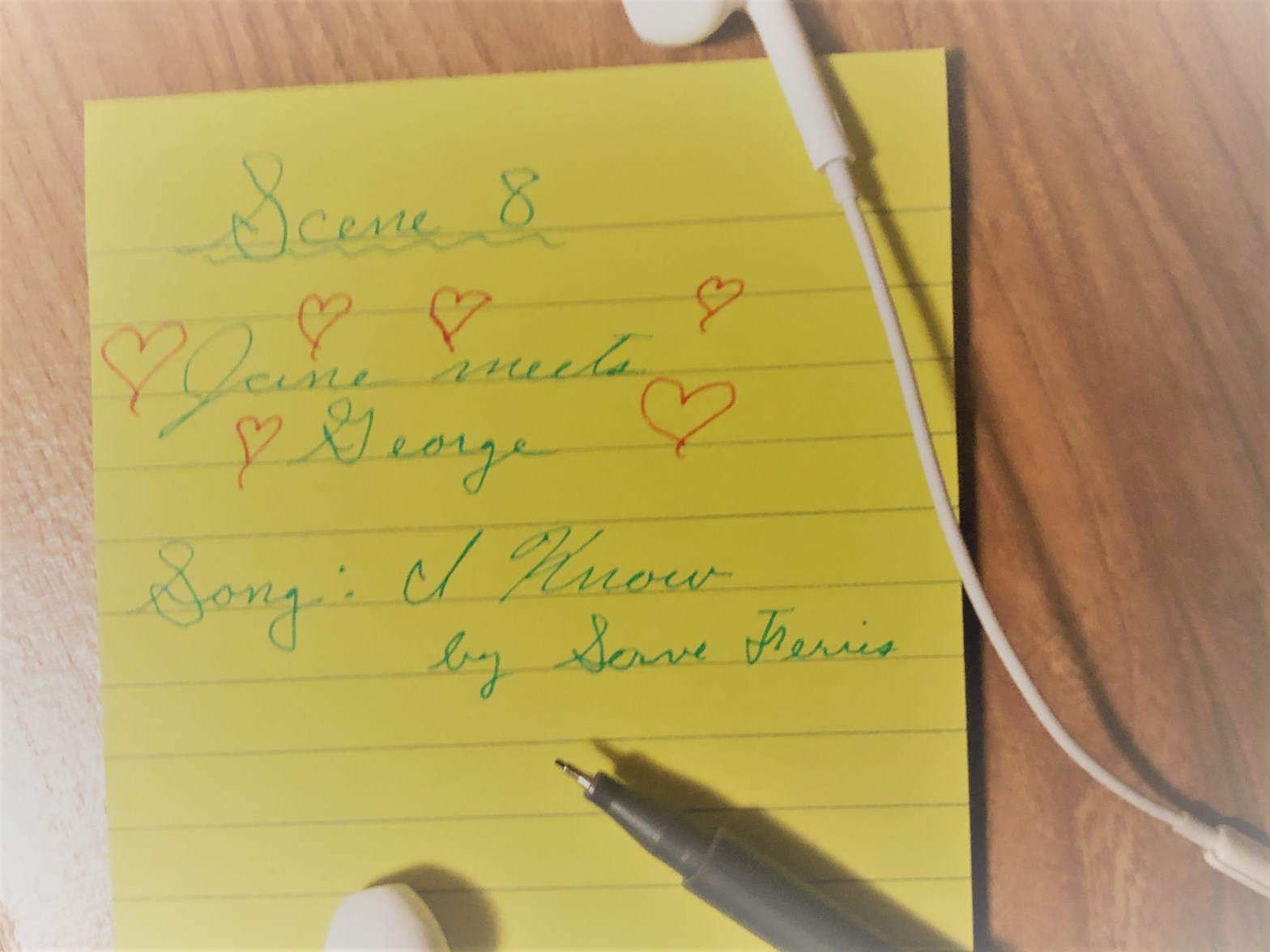
First, when I’m brainstorming an idea, I will often put on Pandora, or just shuffle my own music, and let the ideas come. This is something I like to do when I’m cleaning around the house because, not only can I get more done while also working on writing, but I find that the activity often helps my brain function. When a song hits, and I start to envision a scene for my story, I grab a notecard to jot down the song and anything that I can think of about the scene. Later I shuffle these notecards around to make a full story and ta-da! I’ve got myself an easy outline. I also have a playlist all ordered and ready to go.

The added benefit of this is that often when I hear those same songs again later, I get shoved right back into the story. This is particularly helpful when I need to go back for revision after a long break from the story. I have a tendency to want to move on to the newest, shiniest project. I may have forgotten why I ever liked that old story in the first place. And then I hear the playlist and it all rushes back.

On a side note, this is how I made up stories before I even started writing. When I was a kid, I loved to think up new stories that happened to characters from my favorite movies and tv shows. Yes, fanfiction would become a major thing for me in the coming years, but even before I knew what fanfiction was, I would make mix tapes and play them over and over again while picturing the story in detail in my head. That was how I would go to sleep every night—like telling myself my own bedtime stories.

You would think that it would have been a straight path from doing this method naturally as a child, to using it as an adult, but not so much. It actually took me a shockingly long time after I started writing novels to figure out that this could work for outlining. Like an embarrassingly long time. Like, I’m 33 now and it’s only been a couple of years that I’ve been outlining this way.

Some paths aren’t straight, okay? Some roads are winding with detours and roundabouts, and I personally take a lot of bad turns. Anyone who knows me can tell you that I get lost easily.

I do something similar when I’m developing character’s backstories, though I generally am not doing chores. Instead I have a notebook or a computer out in front of me and stare at the wall (or out a window or at the cat, etc.) until a song gives me some inspiration and then I just start writing. I keep hitting repeat as long as I need to. I’m grateful for headphones, because I’m sure my husband would get real annoyed hearing the same song a dozen times in a row. I certainly would if I wasn’t completely focused on my story.

I like to write little vignettes about events in my characters’ pasts. They don’t have to be long. They don’t have to be well written. They don’t even have to be complete. These aren’t for anyone else, just me. Writing these snippets of backstory helps me to learn more about my characters in a way that feels organic. I don’t feel like I’m sitting there making things up, even though in actuality that’s exactly what I’m doing. But it feels like the stories are just wafting toward me on a summer breeze. All I have to do is reach out my hand and catch them. That’s what true inspiration feels like to me. The surest way for me to get there is through music.

There are times when I haven’t made a specific playlist for my story, that’s okay, too. I mean it’s not quite as good, but it’s fine. Instead what I do is I will typically pick a Pandora station that has music similar to what I might want for my story and just let it play. It’s not tailored to each scene, but it still helps me get into the story. For example, in 2017 I wrote a novel about pirates and I used a station based on the Pirates of the Caribbean soundtrack. I ended up listening to a lot of epic/adventure type scores for movies and tv shows that were exactly the vibe I wanted for that book.

Currently I’m writing a series of novellas that are set both in modern times and in the 1920s, so I’ve been listening to a lot of Postmodern Jukebox. Which, if you don’t know is a band that plays modern songs in an older style. I would say the styles vary from 20s to 40s, but I’m not knowledgeable enough about music eras to really be able to say “Hey! This sounds like the 40s! It’s no good for my story.” It all pretty much works for me.

So that’s how I use music. Sometimes I curate a playlist; Sometimes I don’t. Either way, I almost always have music playing in the background.

Do you use music in your writing? How do you build a playlist? Or are you someone who needs complete silence in order to work? Or maybe you prefer ambient noises instead? Let me know down in the comments!

Please like, follow, and share if you’ve been enjoying my blog. It would mean the world to me!

-Robin

Milwordy: Week 7 Thoughts

Stats

Average Daily Wordcount for This Week: 3,628

Week Total Wordcount: 25,396

October Total Wordcount: 61,296

Year Total Wordcount: 161,366

Words to go:

Month: 22,038

Year: 838,634

I’m beginning to feel that the Milwordy habit has actually started to solidify in my brain.

Don’t get me wrong here, I’m well aware that at any moment I could slip and let the habit fall to pieces. It’s still delicate and relatively new. But there were several days this week when I would have liked to simply stay in bed and sleep in.

You know what I did?

I got up early, every single day and wrote. And it wasn’t so much a matter of forcing myself to do it. I did it almost compulsively.

There are a lot of opinions out there about how long it takes a habit to form (or to be broken). You’ve probably heard 28 days or 66 or a full 365. I don’t know what the exact answer is—I’m pretty certain there isn’t one—but I will tell you that half-way into my second month, it’s beginning to happen. Yet I know, that to keep it up, I will continue to have to nurture that habit. Probably for the full year. Beyond that if I want to keep writing every single day (and I do). Even well-formed habits can be broken.

Another interesting thing that happened this week is that I began to realize just how many words I can get through outlining alone. I spent a lot of time outlining this week. Specifically, I worked on my outline for the Regency Romance I’m planning to write for NaNoWriMo, as well as the outline for a Halloween short story I came up with. I was really shocked at how many words I was able to rack up with just plotting alone.

This, frankly, is a relief. Trying to get all of my words through drafting alone is pretty exhausting and I like being able to switch my brain into a different gear every once in a while. I think this will be super helpful as I continue on this Milwordy journey.

One more thing I learned this week is that using dictation software is also pretty awesome. I tried out Dragon Anywhere this week, and though I don’t foresee giving up typing to use dictation all the time, I can definitely see how it can be a nice change of pace, and a break for my poor wrists. Plus, I can be up and moving while still writing, which is great. The accuracy isn’t perfect, but then, when I’m attempting to type fast, my accuracy is a little off anyway. It is expensive for more than the free trial though, so that’s definitely another thing to consider. If I were making money from my writing, that’s definitely a business expense I would consider worthwhile.

So that was my 7th week of Milwordy. How has Milwordy been treating you so far? Are you starting to feel the habit forming? If you’re not doing Milwordy, do you have a solid writing habit? Did you find it difficult to form, or did it come naturally?

If you like this blog, please like, follow, and share it. If you have any comments or questions, I’d love to hear them!

-Robin

Snowflake Method Week 4

If you haven’t been following Structure Saturdays so far, you can go back and check weeks 1, 2, and 3 for more information. In short, I’m testing out the Snowflake Method for outlining my NaNoWriMo Regency Romance novel.

This week was…okay.

It was all about the characters this time. As I said before, I do like thinking about the story beats from each character’s point of view. Just…something seems to be missing, you know? Let’s talk about it.

Step 7: Fill out more details in the characters’ charts

Since I’ve already shared with you quite a bit about Jane and George, I figured I would make this week all about Jack Campbell. By the way, I will be changing his name because I don’t love the Jack and Jane thing. Too similar. I just haven’t figured out what I want to name him yet.

Names are hard, okay?

For now, he’s Jack. And Jack’s character came together a lot for me this week. So, I guess that we can consider that a win for this method.

There’s not a specific character chart for the Snowflake Method, though it does suggest several things (birthday, physical description, etc.). I’ve used the suggestions on the Snowflake Method website here in addition to several other things that I’ve cobbled together from Scrivener’s character template and various other places over the years. Here’s what I’ve got:

Anthem: Dancing Through Life (from Wicked)

       Role in Story: Minor antagonist. Red herring love interest.

Occupation: Landowner

Age: 24

Birthday: April 2

Physical Description: Sandy hair. Green eyes. Soft, plump lips. Wide shoulders. Relatively tall, but not as tall as George.

       Defining Feature: Plump lips

       Personality: Life of the party.

Mannerisms/Quirks: His eyes sparkle with mirth. He throws his head back in laughter often. He speaks loudly, with little care for who hears him most of the time. He is charismatic, which is why no one shuns him for his occasional bad behavior. He moves quickly and gracefully. He gives secret smiles that make people feel like they’re in on some private joke, even if they’re not.

Why Funny:    Witty and lively.

Background: He was orphaned at a young age and sent to live with his uncle. His uncle was a workaholic who tried to impart the same work ethic onto Jack. Jack, however, learned the opposite lesson. He saw the way that his uncle worked himself to death and was determined not to let the same thing happen to him. Now he takes very little seriously. He enjoys living moment to moment and following his feelings, whether they lead him into infatuation, or gambling, or dancing. He does whatever strikes him as the most fun at the moment.

                                                         He has engaged in little flings here and there, but mostly with women who were not nearly so innocent as Jane. They knew their own minds and were savvy enough not to get caught up in anything that would ruin them. Jack is unused to interacting with someone that cannot always see where their best interests lie

Goal: To charm and seduce Jane.

Motivation: He enjoys being in love (briefly) and having fun. He enjoys causing a stir. And there’s a little part of him that feels sorry for Jane the pariah and thinks a little fun will help her.

Internal Conflicts: He does have a good heart, but he doesn’t always stop to think about the consequences of his actions. He doesn’t want to marry Jane, but he feels responsible for her predicament.

External Conflicts: Society thinks he’s a rake, which leads some to think scornfully of him, though not everyone, and he actually disdains those that think poorly of him but treat him well anyway.

Epiphany: That his actions have consequences for others besides himself.

Want: Infatuation. Fun.

Need: Love. Responsibility.

Fears: Being locked in a passionless marriage. Boredom. Working himself to death like his uncle. Allowing responsibility to sap joy from his life.

Strengths: Charming. Funny. Kind hearted.

Weaknesses: Careless. Driven by fear of becoming his uncle. Self-centered. Immature.

Vulnerabilities: Wants to think of himself as someone who doesn’t care what anyone else thinks of him, but ultimately can’t stand to truly be the bad guy.

Tragic Flaw: Cares about other people, but has no actual idea how to care for them.

Contradiction: Is both caring and careless.

Shard of Glass: The uncle that raised him died of a heart attack, having rarely taken a day off in his life and stressed about everything.

Start: Only interested in having fun doesn’t care about what the ton thinks about anything.

End: Takes responsibility for his mistakes and learns that though he can live with a bad reputation, others may not be so lucky.

Competent:                               3

Proactive:                                   3

Likable:                                      4

Notes: A young rake is forced to offer marriage to an awkward debutante whose reputation he has compromised.

Character’s Plot Synopsis:

Since the death of his uncle, Jack Campbell has sought only to find pleasure in life. He doesn’t wish to toil his life away only to die of a heart attack like the uncle who raised him. He has gained a reputation as something of a rake, but he doesn’t mind. No one expects him to be too proper or to offer any young lady his hand in marriage. He is able to have his fun without much interference from the ton.

Jack expects this Season in London to be much the same as every other. He looks forward to card parties, dancing with beautiful women, perhaps even causing an infatuation or two. He loves to be in love, but only for a short time. He doesn’t give too much thought to the hearts he might break, because he thinks everyone should be as carefree as he. He even considers himself to be a teacher of sorts in the art of not taking life too seriously.

As it turns out, his time in London starts out quite boring. He finds that some of society has turned their backs on him and those that haven’t have become very dull and predictable to him. He begins to feel that this Season will be an entire waste. Then he meets an awkward debutante, Jane Templeton, who he finds funny and charming in a strange sort of way. He decides that lavishing her with the compliments and attention that the rest of society denies her will be his amusement for the Season.

Jack enjoys Jane’s company, but knows that this is a woman he could never fall in love with. And, after seeing the way that she reacts to George Beaumont, and he to her, he has little concern that she will really fall in love with him. Even when the gossip’s tongues begin wagging, Jack pays no heed to the impression of attachment that is beginning to spread. One evening at a ball, Jack convinces Jane to go stargazing with him, however they stay out far too late. When they are discovered, Jack realizes that Jane’s reputation will be in jeopardy and his conscience bids him to marry her, though he does not want to.

He proposes to her, though he knows he does the job poorly. He can’t hide his true feelings on the subject, even to spare hers. For once in his life he must take responsibility for his actions. Though he knows that Jane almost certainly must say yes to save her own reputation, he desperately hopes she will say no. In the end she turns him down and he vows not to be caught up in such marriage plots again.

I like that Jack has a little more complexity than just a flat bad guy. He’s not putting Jane’s reputation in danger due to maliciousness, but carelessness—a trait that by the end he will have learned needs to change. And ultimately, he’s not really a bad guy even if he is the cause of some major trouble for our heroine. I wouldn’t even call him the antagonist (that honor, I believe, goes to Jane’s mother. Although I think internal antagonism plays a role in this story as well).

One thing that I worry about with these characters is that I’ve made too many outcasts. Jane is shy and awkward. Her mother is anxious and a recluse. George is snarky and disinterested. And Jack is a bit wild. Jack and George aren’t ostracized exactly, but they definitely don’t fit the mold of society quite right. I can’t tell if there is too much sameness here, or if it’s fine, maybe even commentary on how no one is quite “normal.” It might be all right, it just seems that this story about one misfit has become a cast of misfits, and does that spoil the point a bit?

That may be something that I can tinker with as I get deeper into the outline, or even the first draft. We’ll see.

As for the rest of the character chart, it’s pretty standard stuff. The website for the Snowflake Method doesn’t give a ton of details about what should be included in this step, so I’ve pretty much fallen back on the character chart that I’ve been fiddling with for years. Every time I find a new point that will help me understand my characters better, I add it to the chart. Maybe going forward I will be adding the “plot synopsis from the character’s point of view” that is part of the Snowflake Method. I think it could be helpful.

This was the last step that deals explicitly with characters, though I suspect I’ll have to go back and repeat this with any new characters that pop up during my outlining. I’m kind of glad this part is over. As I’ve said before, this is not my favorite way of creating characters and though I could see myself using some of the Snowflake Method in the future, I doubt I’ll be using it for characters again, at least not in this exact way. I’ve told you previously that I like to write vignettes of character backstory in order to help me build the characters. And only then do I start filling out charts like this. Maybe if I had spent more time developing the characters before starting this method, I wouldn’t have felt so much like I was pulling stuff out of thin air to fill out character charts.

Next week is our penultimate week! I’ll be covering Step 8, which you can find details on here. I get to make a spreadsheet! Essentially, what I will be doing is finally coming up with individual scenes. I have no idea how this is going to go. Will it be easier now that I have a 4-page plot summary to work off of? Only time will tell!

If you’ve been enjoying Structure Saturdays, please like, follow, and share this blog. You can follow me on Twitter and Instagram as well. If you have any questions or comments, don’t be shy! I’d love to hear from you!

-Robin
Milwordy: Week 6 Thoughts

Stats

Average Daily Wordcount (Week 5): 3,507

Week Total Wordcount: 24,552

Year Total Wordcount: 135,970

Words to go:

Month: 47,434

Year: 864,030

What did I learn this week?

I learned that when your day job is asking you to work overtime, Milwordy gets much more difficult. I still made my goals, but it was exhausting.  I’m not sure how long I can keep this up if I don’t get a little relief from work.

I didn’t take days off this week because my spreadsheet is a little screwed up and I honestly thought I was further behind in my weekly word count than I actually was. So that means that I also learned how important days off are. Now, I have yet to take a complete day off from writing during Milwordy. But for instance, on one of my days off last month, I only wrote 30 words. Not exactly a taxing writing day. It was good to rest while also feeling like I was keeping my momentum going. Days like that, where I can give myself a break are vital. This week I felt like a too tight guitar string and yeah, there were a few times I almost snapped. I’m hoping work will calm down soon so that I can get some rest.

I also learned that I start getting bored of working on the same project for more than a month. I’ve been working on this novella series for the entirety of Milwordy so far, and yes, each novella is its own story, yet still, I’m finding it difficult not to hop to another project. This is…not entirely a shock to me.

Fun fact, my college had strange semesters. We split the semesters into 12 weeks (in which we started and finished the bulk of our classes) and 3 weeks (in which we started and finished one class). The first time I experienced the 3 week, I was like “Why aren’t all classes like this???” I do extremely well when I can hyper-focus on one thing for a short amount of time, 3 weeks to a month being pretty optimal. It’s one of the reasons I love NaNoWriMo. It’s just my kind of thing.

And, if I play my cards right, I can make this work for Milwordy as well, but the trick is, I think, not to allow myself to work on the same project for more than a month. Mostly this shouldn’t be that difficult. I don’t write epic fantasies that are over 100k. In fact, I’m a pretty sparse writer in the first draft, so even getting my novels up to 80k is a struggle. That means, I can basically focus on starting and finishing a novel in one month. But this requires planning.

The novella thing seemed like it would be perfect for me, but I think sticking within this same series for this long was a mistake. Aaaand I still have one more novella in the series to finish before NaNoWriMo. I breaking up the monotony a little with a Halloween inspired short story though, so hopefully that will help.

If you’re also doing Milwordy, I would love to hear how it’s going. Are you on track? Have you been working on multiple projects or just one?

If you’re not doing Milwordy, I’d love to hear what you are working on.

Either way, let me know if you find it difficult to work on the same project over an extended period of time. I’m fascinated by how different we all are in terms of our writing processes.

If you’re enjoying this blog, please like, follow, and share. And I’d love to hear from you if you have any suggestions for what you’d like to see me talk about next.

-Robin

Snowflake Method Week 3

This step pretty much took me all week, so I’m grateful that I only had to do one step instead of two. Of course, I could have done it a little faster if I wasn’t also in the middle of drafting a novella for Milwordy, but such is life. What kind of a me would I be if I wasn’t biting off more than I could chew?

Anyway, this is my third week trying the Snowflake Method. Let’s get into it.

Step 5: Expand your 1-page plot synopsis into a 4-page plot summary

Like I said in my post last week, I’m not going to post everything I did here. That would be a little much. But I think you can get the gist with what I’m about to show you.

If you’ll recall, I first wrote a plot description paragraph, the first sentence of which went something like this:

An awkward, late-blooming debutante goes to London for her very first Season.

I expanded that sentence into this paragraph:

Having spent the entire 22 years of her life away from high society, a debutante named Jane is eager to spend her first Season in London. Though her mother regrets agreeing to go to London in the first place and complains about town nonstop, Jane is hungry for new experiences. As Jane moves into society, she is intimidated by all the social rules that everyone else seems to understand naturally, but she has never learned. She often makes a fool of herself by either talking too much or too little, and never about what she should. Though Jane was able to make a friend in Lady Arabella during the first half of the Season, she is abandoned when Arabella marries.

That first sentence gave a pretty basic idea of what the story is about, but the paragraph adds some details. It’s still not super in depth of course, but it shows why this is Jane’s first season and also hints at the relationship she has with her overbearing mother. It also reveals a little about what form her awkwardness will take. See how this method starts broad and eases you into the specifics?

And now I took that paragraph and expanded it into the following 5 paragraphs.

As a child Jane Templeton was prone to illness. Her anxious mother kept her from most society, for fear of her daughter’s condition worsening. At 22, Jane has been well for several years, but her mother is still reluctant to let her go out into society. Jane is very nearly too old to make a proper debut in society and so begs her mother to take her to London for the Season before she gets to be even another year older. Her mother grudgingly relents.

From nearly the moment they reach London, Jane’s mother longs to return to the country. She tries several times to scare Jane into wanting to turn around and go back home. She tells Jane horror stories about what happens to those that become pariahs among the ton. She overloads Jane with all the social rules that she had never bothered to teach her before. Jane, however, is hungry for new experiences and cannot be convinced to return home.

Jane is immediately enchanted by the beautiful clothing and elegant manners of the ton. Being a wealthy debutante brings Jane an initial welcome into society. However, after her very first ball, Jane realizes that her mother maybe right about her inability to fit in among the ton. She has no idea how to be introduced properly, which offends many. Even those who are initially friendly turn against her as she is shown to be a bit of a rube.

After her first week in London, Jane finds that she receives fewer invitations than she had initially. When she is out among large groups, she finds it hard to remember all the rules that her mother had tried to instill in her. The more she gets wrong, the more nervous she becomes, which makes it even harder for her to stay on track. She often makes a fool of herself by either talking too much or too little, and never about what she should. Soon she is barely being talked to at all.

Jane is fortunate enough to make a friend in Lady Arabella, a woman who is very knowledgeable in the ways of society. Arabella attempts to teach Jane to do what she should, but the lessons don’t seem to stick. Jane is grateful to have a friend in Arabella, as well as a slight acquaintance with Arabella’s friends, including a surly widower named George Beaumont. The comfort Jane finds in Lady Arabella’s company is brought to a sudden halt when Arabella marries and leaves London before the Season is over. Though she is very happy for her friend, Jane feels abandoned.

See, now we’re getting even more details! I definitely see some actual scenes forming out of this and this is only the very beginning of the story.

All in all, I think the Snowflake Method does just exactly what it promises. It allows you to start with a broad idea and then start to hone in on the details. I’m enjoying the method so far, though there are a few things that I’m not entirely certain I like.

First, though this is kind of easing me into the details of the story, I do find myself adding some filler sentences, just to get to the full plot summary. Sometimes the filler leads me to a discovery about the story, like when I wrote that “Jane was enchanted with the beautiful clothing and elegant manners.” That wasn’t something I knew about her before the step. On the other hand, sometimes filler is just filler. For instance, there is more than one sentence here that reveals how Jane’s mother hates taking Jane to town. I probably didn’t need all of them for my discovery process.

Second, usually after several weeks of outlining, I would have gotten a little more specific with scene ideas. I worked out a few based on this method, but I’ve still got a long way to go. Then again, Step 8 is about coming up with scenes based on the plot summary, so perhaps that’s where I will really get into scene making. We’ll see how that works out.

That’s it for this week. Next week I will be working on Step 7, which is basically filling out the character charts more. You can find the details here. As I’ve said before, this isn’t necessarily my favorite way of creating characters, and I don’t see my mind changing about that in the next week. But surprises do happen. We’ll have to wait and see!

If you’ve been enjoying Structure Saturdays or my blog in general, please like, follow, and share. If you’ve been trying out the Snowflake Method with me, please let me know down in the comments what you think of it so far. I would love to hear from you!

-Robin

Enjoying My New Writing Space

Recently I cleared off my desk and, I have to tell you, it made a huge difference in the writing experience for me.

Now, I’m a pretty firm believer that you can and should write wherever you need to. Have a long flight while traveling? Bust out that laptop! Meeting friends at a park, but they’re running late? Type out a few paragraphs on your phone! Have a long bus commute? Bring along a notebook and pen!

However.

Just because you can write anywhere, does not mean that those places are your ideal spots, and when it comes to your routine, you should think carefully about where you plan to do the bulk of your writing.

If you’ve been following me on social media, you may have noticed that I’ve been complaining about some wrist problems lately. But you know what simple fix helped that? Sitting at my desk with good posture, instead of lounging on my couch. I’m not saying that I’m ditching my lap desk now and refusing to write on the couch ever again. What I am saying is that I’m aiming to do the bulk of my writing in a place that will not cause me pain.

And you know what? There were extra perks that I did not expect. For one thing, I actually find it easier to avoid procrastination at my desk. It just feels like a place where I should be working. I don’t have the tv in front of me. I don’t have my husband sitting right next to me (sorry my love, but you are very distracting). And our two cats are less likely to worm their way between me and my laptop. Not that they’ve stopped completely, of course, but the activity certainly has decreased. It’s easier for me to get my words done faster without all the distractions.

Plus, at my desk I have all my writing related books and notebooks, not to mention notecards and pens etc. I no longer have to go through the whole process of setting up the couch area for my writing. My desk is always ready and waiting for me.

Another small, but nice touch is that I can light a candle at my desk while I’m writing. Currently I have a Pumpkin Spice candle burning and it’s really been giving me some nice Fall vibes. Altogether the writing experience at my desk is just more pleasant.

And I think that the division between my writing world and my relaxation world aka the couch is healthy. Milwordy is a tough challenge and mentally it’s a relief to have that separation between “work” and relaxation.

Everyone is different, so what you need in a writing space, may be very different from what I needed. Let me know down in the comments if you have a dedicated writing space or if you write anywhere you get the chance. And if you do have a dedicated space, is it a desk? Your couch? Your kitchen table?

If you’re enjoying my blog, I would love it if you could like, follow and share. And of course, if you have any suggestions for what you’d like me to talk about next, leave them down in the comments!

-Robin

Milwordy: Week 5 Thoughts

Stats

Average Daily Wordcount (Week 5): 2,931

Week Total Wordcount: 20,520

Year Total Wordcount: 111,418

Words to go:

Month: 71,986

Year: 888,582

During weeks 3 and 4 I had the challenge of writing while sick, which fortunately didn’t slow me down too much. I just had to figure out how to write while lying down, which thanks to the lap desk I gifted myself at the beginning of this challenge, wasn’t too difficult.

During week 5 my big challenge was the day job. We were very busy this week, which not only meant working Saturday, but because my job is physical in nature, it meant that I came home tired and sore every night. I wasn’t inclined to write in the evenings for the most part, which meant making sure I got up early enough to get all my writing done before work. Which meant I was extra tired. And so the circle of exhaustion continued.

Though I feel like the past few weeks have been extra challenging—I’m not usually sick and we’re not usually quite this busy—I’m beginning to wonder if every week is going to have these “extra” challenges. Certainly, if the pandemic ever actually goes away, there will be more demands on my time from family and friends. Not to mention the fact that I think my husband is getting cabin fever and all he wants to do is go out to restaurants again. But what else might pop up along the way? I’m beginning to wonder if these challenges aren’t actually “extra” at all.

Other than feeling a little squeezed for time, I enjoyed week 5. I’m getting really excited for NaNoWriMo. I’m liking using the Snowflake Method to plot my novel. Also, I’m pretty psyched to actually have an outline to work off of again, because I’ve got to be honest, I think pantsing is stressful. I’m envious of writers who thrive without detailed outlines, I’m just not sure I could be one of them long term.

One of the big things I learned this week is something I should have already known: I need to straighten out my priorities. I’ve started slowing down on the social media stuff, particularly Instagram. I was posting twice daily, but I’ve scaled back on that. I was mostly finding it stressful. Plus, I think for me, trying to do that many post sacrifices something in quality of posts. Demanding of myself that I post twice daily meant not only coming up with new pictures every day, but also new captions. The fact is, I don’t always have that much to say on social media and I need to focus on the writing first and foremost. Especially in weeks like this one when I was super busy anyway.

I also finally cleared off my desk, which has made a huge difference in my comfort while writing. Who knew?

How is October treating you so far? Are you being productive? Are you decorating for Halloween? Have you watched Hocus Pocus as much as me? We fall asleep to it every night, so I’m guessing your answer is no.

If you’re enjoying this blog, please like, follow and share. I post 2 to 3 times a week. And if you have any suggestions for things you would like me to talk about, let me know in the comments.

-Robin